Review·by Benjamin Hoffmann·October 26, 2026
Si Rome n’avait pas chuté, by Raphaël Doan
On Si Rome n’avait pas chuté (Passés composés)
An alternate history written in dialogue with artificial intelligence: what if Rome had invented the steam engine? A fascinating experiment that above all reveals how conservative the machines’ imagination is.
While the Thélyson Orélien affair has not finished stirring controversy, implicating a writer accused of having used artificial intelligence without admitting it, a book from 2023 made use of AI in all good faith, making the dialogue between the machine's proposals and the expertise of its human interlocutor the central stake of the text. Published by Passés composés, this book by Raphaël Doan is titled Si Rome n'avait pas chuté and belongs to the genre of the uchronia (alternate history), a genre inaugurated in 1857 by Charles Renouvier when he began a text called Uchronie (l'utopie dans l'histoire): an apocryphal historical sketch of the development of European civilization as it did not happen, as it could have happened. This genre now has an illustrious literary history: one need only think of Philip K. Dick's The Man in the High Castle (1962) or Philip Roth's The Plot Against America (2004), two texts that rewrite the history of the twentieth century by imagining, in one case, the victory of the Axis powers in the Second World War and, in the other, the election of Charles Lindbergh in place of Roosevelt in 1940, a prelude to a rapprochement between the United States and fascist Europe.
Walking in the footsteps of the genre's founder (Renouvier invents an alternative history that would have begun if, from the reign of Marcus Aurelius onward, Christianity had not spread across Europe), Raphaël Doan in turn turns to the Roman Empire. A specialist in classical literature, he is indeed well placed to exchange with artificial intelligence about the direction Roman history might have taken if (this is the starting point of the historical deviation he envisions) the steam engine had been invented in the first century of our era. The supposition is not as gratuitous as it might seem, insofar as an ancient machine did indeed anticipate the one James Watt was to perfect in 1769. Called the aeolipile, the boiler invented by Hero of Alexandria under the reign of Nero contained steam that made a sphere spin at a sustained speed. In the absence of techniques capable of ensuring an airtight circulation of steam, however, this creation had no immediate posterity and failed to revolutionize the Roman world. This is where artificial intelligence intervenes to suppose a greater success for Hero which, in the parallel world whose history it unfolds, becomes the starting point of a history in which, far from falling, Rome never ceases to grow in power.
Throughout the book, the exchange between the historian and the artificial intelligence continues. The latter pursues, chapter after chapter, the description of what would have happened to Rome from the deviation engendered by Hero's innovation, while the former assesses the degree of plausibility of these proposals and relates the fictional knowledge generated by the uchronic fiction to the authentic knowledge held by specialists of antiquity. Undeniably original, the procedure illustrates the possibilities opened up by artificial intelligence but, even more eloquently, its limits.
Let us begin with the successes. As the author emphasizes in his preface, the AI's discoveries are often striking in their aptness: for example, the Latin expression suggested by text-davinci-003 (a model of the GPT-3 family that the author used in his work) to designate the satellite. It is named "lucerna circumvolans," that is, "lantern revolving around" (p. 22), two words that had never been used together before. The AI evokes not only the technical changes that would have followed one another in Rome after the discovery of the steam engine (the automobile, telephony, and aviation follow quickly, and computing, robotics, and artificial intelligence are not long in following suit) but also the changes in Roman customs that these technological developments would have engendered. In this respect, the idea that technical progress would have been in dialogue with Epicureanism and Neoplatonism ingeniously illustrates the absence of any break in continuity between the sciences and philosophy and the way in which the material framework of a society influences cultural productions as well as the systems of thought contemporary with them.
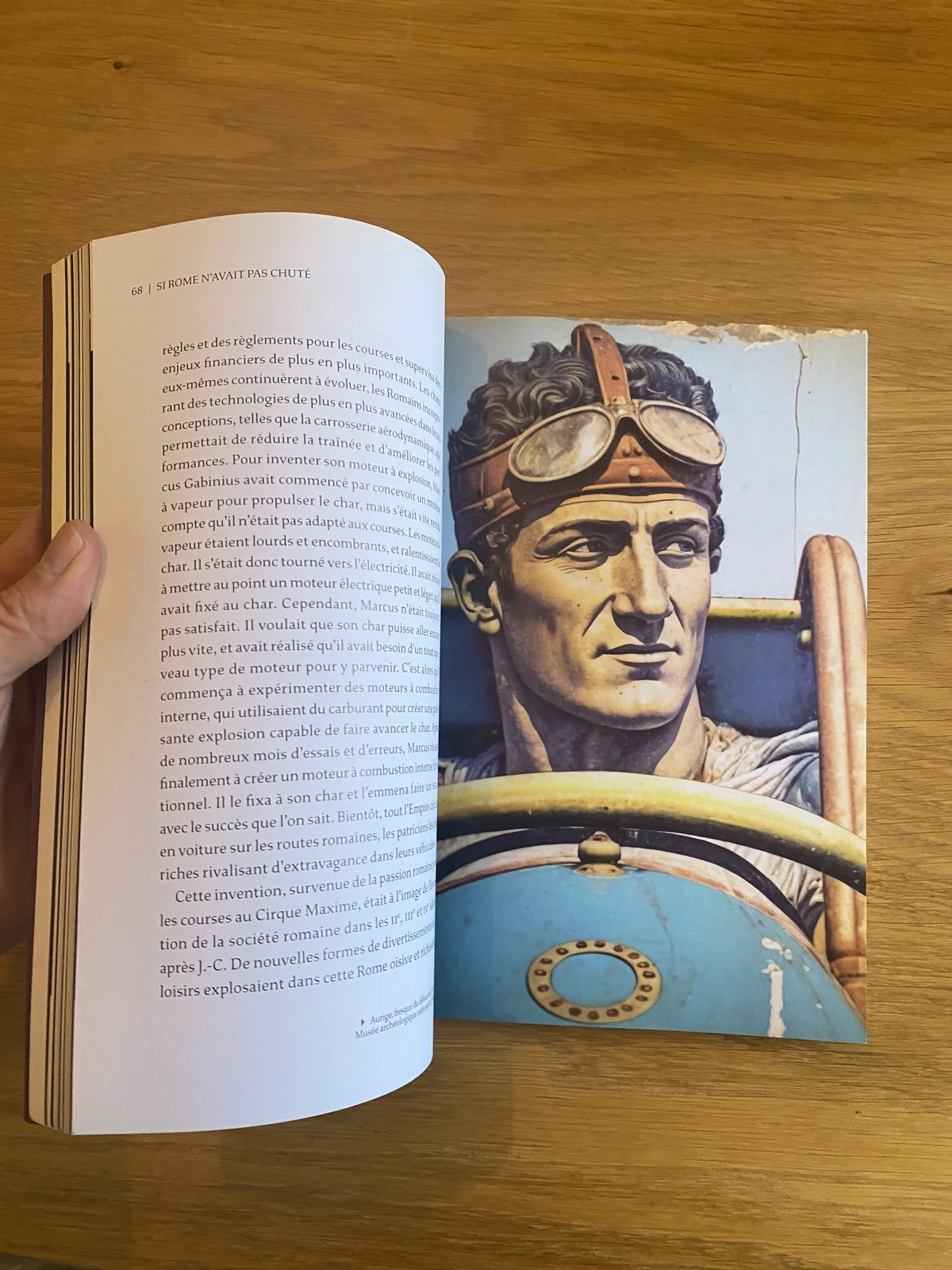
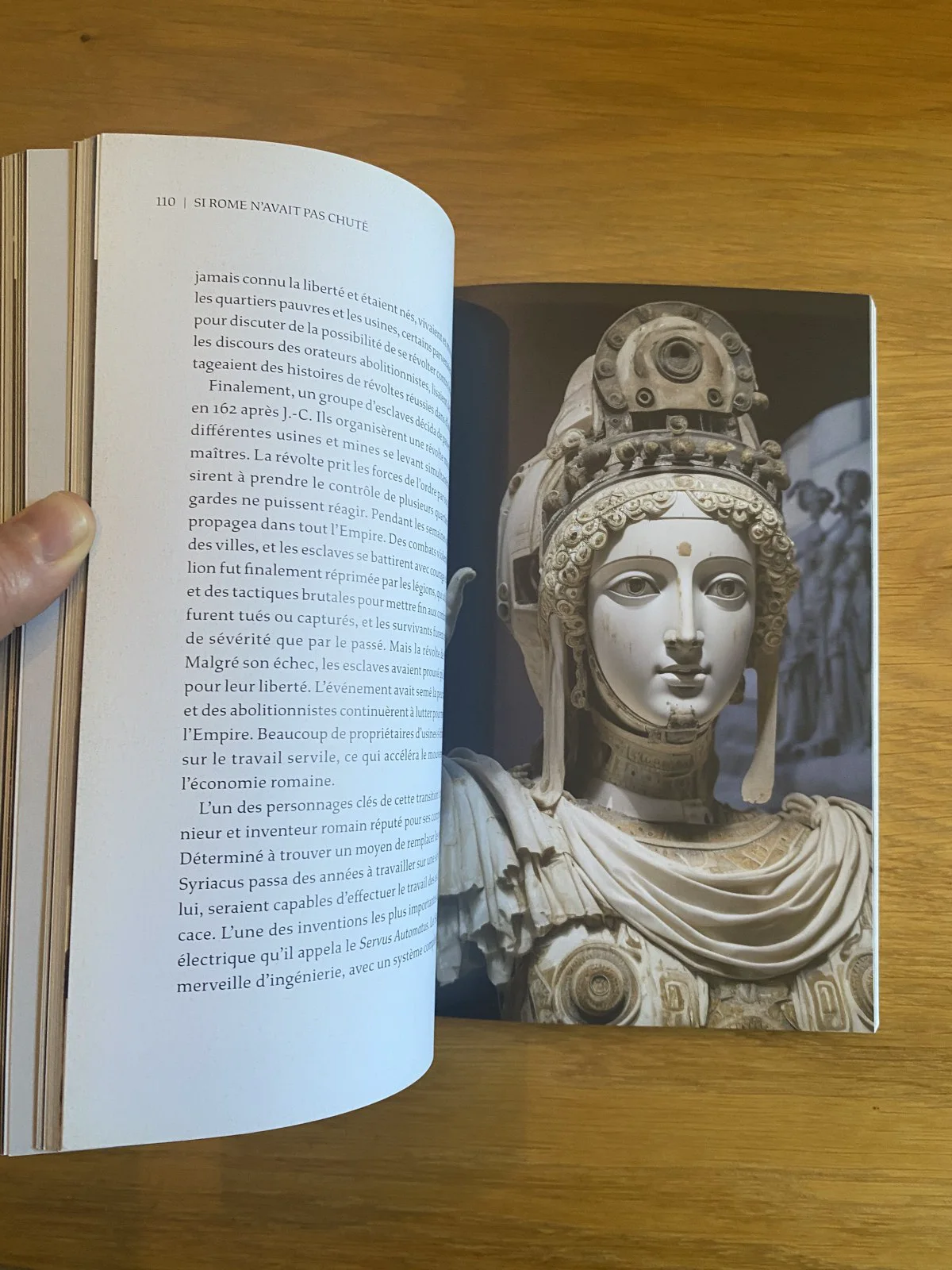
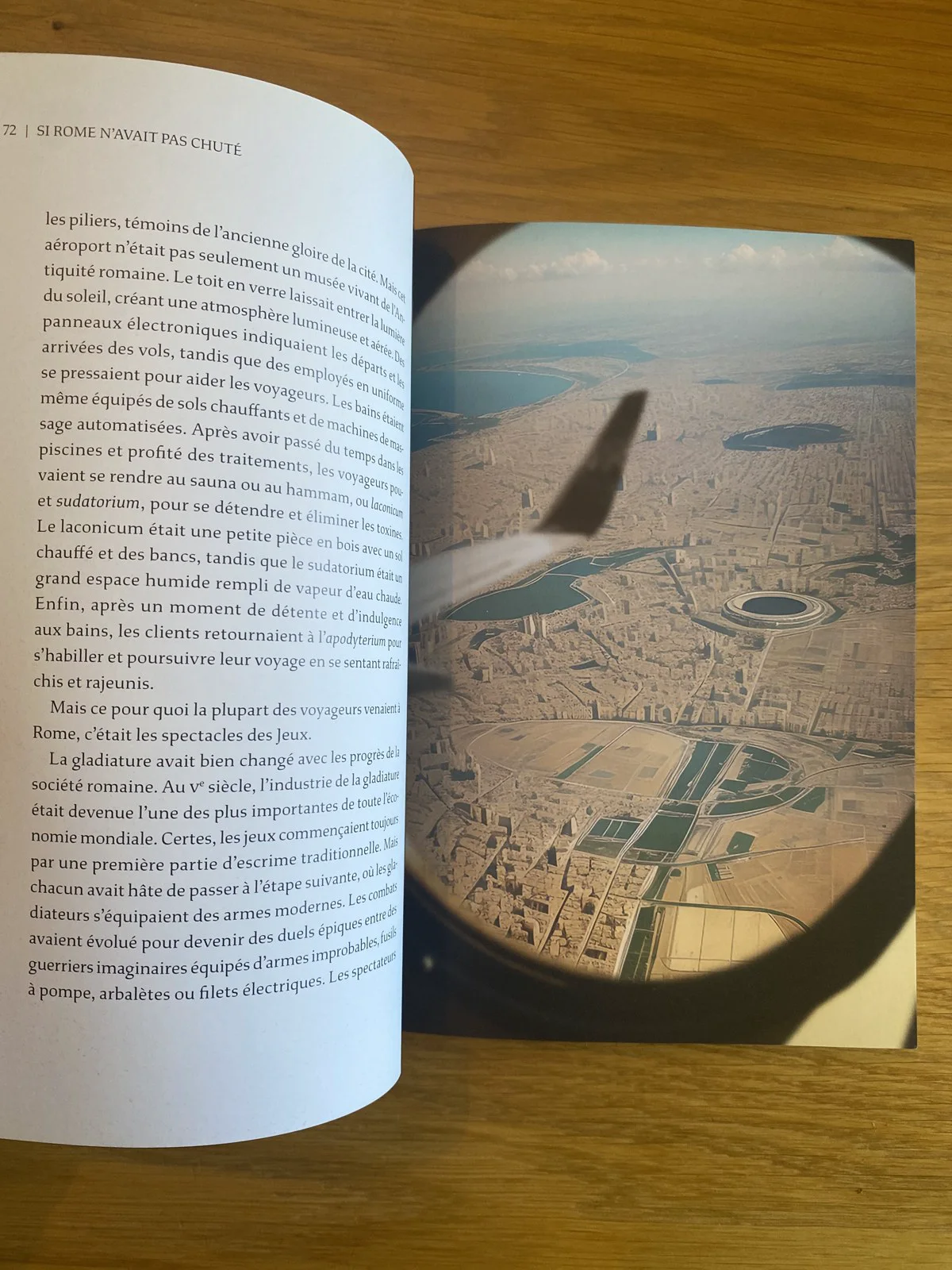
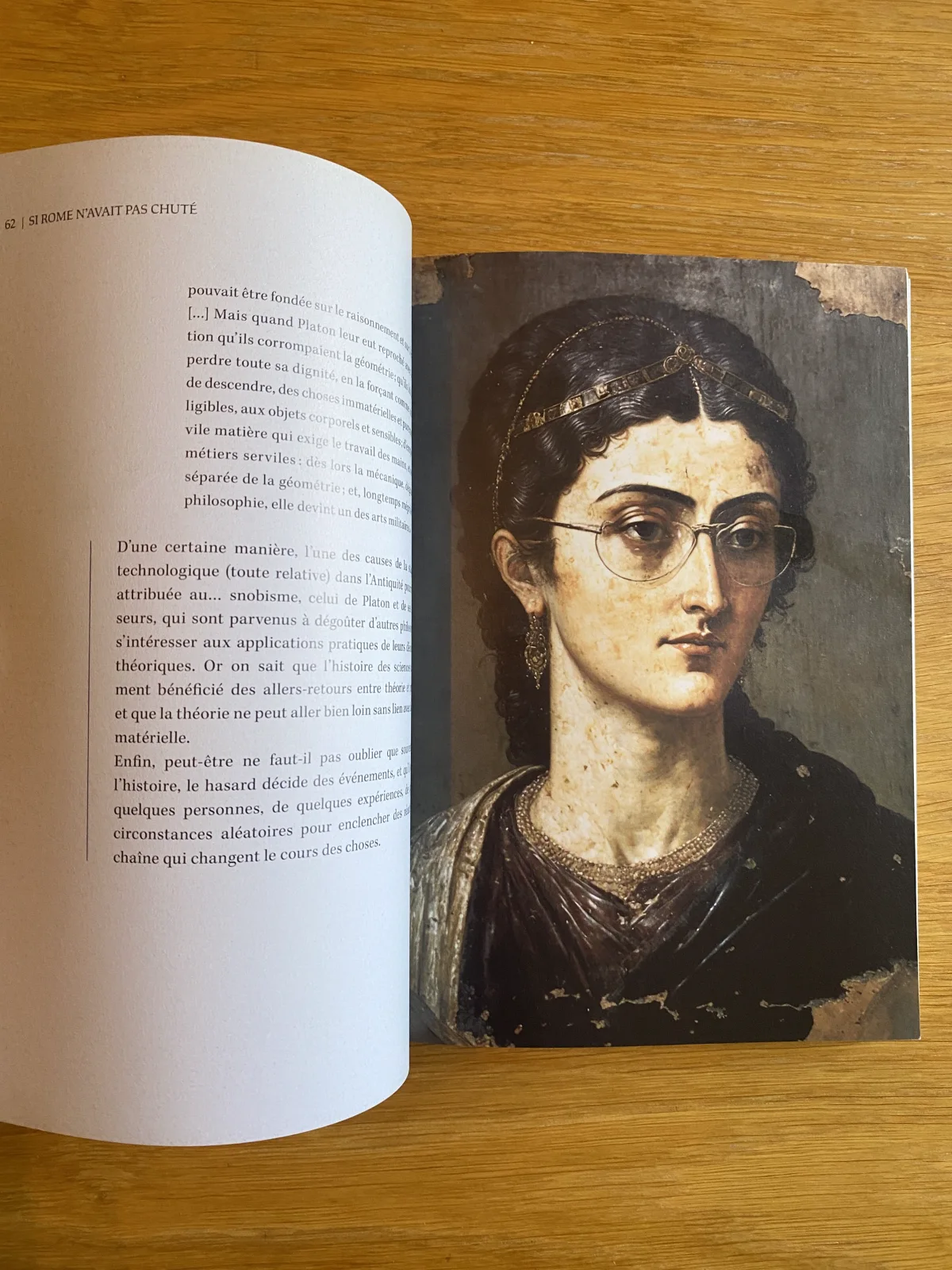
The artificial intelligence does not limit itself to textual suggestions; surprising visual constructions are also proposed, in which memories of ancient iconography as it developed meet innovations occurring in the uchronic history the text invents. Thus we see eyeglasses on the face of a haughty Roman woman, or gasoline-powered cars competing in a race on the tracks of the Eternal City. Some of these images are of a disturbing beauty and recall the pre-surrealist aesthetic of a Lautréamont when he exclaims: "Beautiful as the chance meeting on a dissecting table of a sewing machine and an umbrella!" The illustrations of Si Rome n'avait pas chuté are, for their part, beautiful as the meeting on a computer screen of a Roman sculpture and an android's face. The reader is charmed by this verbal and visual inventiveness, an inventiveness that, however, remains entirely relative.
What is striking in these productions of artificial intelligence is the conservatism with which they are imbued. The text presents a paradoxical form of anticipation novel: what the narrative anticipates is not the future that remains for us, its readers, to discover, but that of Romans whose imaginary reality corresponds closely to our present. Instead of announcing an unprecedented future, the ancient fiction gestures toward the reader's own era, implying a form of historical inevitability. To be sure, the artificial intelligence creates a world in which Rome would have rapidly acquired technologies that, in fact, appeared centuries after its fall; but the discoveries it attributes to Rome are nothing other than those with which the reader is familiar. Romans drive vehicles like ours, and their airplanes are just like those we have built. No original technology is invented: the fiction projects into the past the techniques we have at our disposal today.
More important still, this conservatism of the imagination deployed is redoubled by a latent historical conservatism. Rome remains at the center of the world, and its uchronic customs are merely the continuation of what they were during the ancient period. It is still an empire with gladiators, entertainments for the plebs, and slaves who threaten it to demand their freedom. As the chapters go on, the text produces a paradoxical effect: whereas uchronia presupposes the exponential growth of the historical deviation, the Roman society described by the author resembles ours more and more closely. One thinks of Margaret Thatcher and her chilling formula: There is no alternative. For the AI, it seems that the centrality of a Western empire founded on conquest and technological progress is the only conceivable historical trajectory. Like the United States confronting the growing ambitions of China, the Roman Empire comes to be opposed to the Middle Kingdom, which it endows with expansionist designs and a propensity for industrial espionage. The AI draws on the geopolitics of the present to transplant it, barely modified, into the fictional universe it depicts. An author of flesh and blood might have proposed something authentically new: a future in which the uchronia would have borrowed from the lessons of utopia, for example, by imagining a more equitable economic system, a reasoned extraction of resources, a technological progress whose purpose would not have been to make us "masters and possessors of nature" (Descartes), for instance. Ultimately, the aesthetic and political conservatism of the proposals generated by artificial intelligence brings out this technology's difficulty in effecting, in the domain of cultural production, an authentic rupture, a conceptual rupture allowing the advent of a novelty worthy of the name.
The underlying theory of literary creation advanced by the author is the one he attributes to the artificial intelligence itself by way of an analogy. The AI's inventions are a matter of "recombinations of multiple preexisting sources" (p. 23). Likewise, Raphaël Doan continues: "Human creation, too, is above all a matter of recomposition. Was the Aeneid not a blend of the Iliad and the Odyssey?" (id.). Yet such a theory is insufficient for thinking the singularity of a true literary innovation. On the one hand, it is easy to retort that if the Aeneid did indeed work with preexisting models, those models themselves had to come into being and, consequently, an authentic emergence had to occur. And on the other hand, literary creation is more than a simple rearrangement of earlier forms. As Julien Gracq writes in En lisant en écrivant (1980): "[Proust's work] represents less the creation of what is called a writer's 'world,' that is, the filtering of the objective world through an original sensibility, than the application of a decisive technical conquest, immediately usable by all: a qualitative leap in the optical apparatus of literature." According to Gracq, technical innovation in the domain of literature allows the writer to explore zones of human experience that previously remained unthought, or rather, invisible. Thanks to a discovery comparable to that of a microscope of increased power, "a superior minuteness in the observation of already explored domains" and "access to new domains" suddenly become conceivable. In short, creation is not merely recomposition, the rotation of a kaleidoscope in which a limited number of forms are enclosed; it consists in the introduction of a technical innovation that extends the space of possibilities in literature. No application of a technique of this order is to be found in Si Rome n'avait pas chuté, where the fictional past sends back to the present its reflection, barely modified by an antiquizing filter.
A useful and fascinating exercise, Si Rome n'avait pas chuté does not demonstrate what it intends to prove; it is less a showcase of the AI's creative power than of its present incapacity to effect, in the domain of the imagination, an evolution comparable to the epistemological and aesthetic ruptures that are at the origin of what are called, in English, breakthroughs. The question nonetheless arises: is this inability tied to a current limit of the tool, a limit destined to be overcome as so many others have been? Or is it a constitutive incapacity, linked to the way AIs function? Humility and reserve are in order here; artificial intelligence has not finished surprising us, and the extent of its authentic capacities is still unknown. It is nonetheless permissible to wonder what Raphaël Doan would have written if, instead of guiding text-davinci-003 with his prompts, he had meditated alone on the consequences of the discovery of the steam engine under the reign of Nero, and whether what he would have invented would not have been more complex and innovative than all the fictions of the artificial intelligence.
Hoffmann, Benjamin. "Si Rome n’avait pas chuté, by Raphaël Doan." French Press, October 26, 2026, https://frenchpress.media/publications/si-rome-n-avait-pas-chute-raphael-doan.
Hoffmann, B. (2026). Si Rome n’avait pas chuté, by Raphaël Doan. French Press. https://frenchpress.media/publications/si-rome-n-avait-pas-chute-raphael-doan
Hoffmann, Benjamin. "Si Rome n’avait pas chuté, by Raphaël Doan." French Press, October 26, 2026. https://frenchpress.media/publications/si-rome-n-avait-pas-chute-raphael-doan.